
PGFRB GFRP Rebar: Advanced Composite Reinforcement for Long-Lasting Concrete Structures
PGFRB GFRP Rebar is a non-metallic composite reinforcement manufactured using high-strength glass-fiber rovings embedded in an engineered epoxy resin matrix.
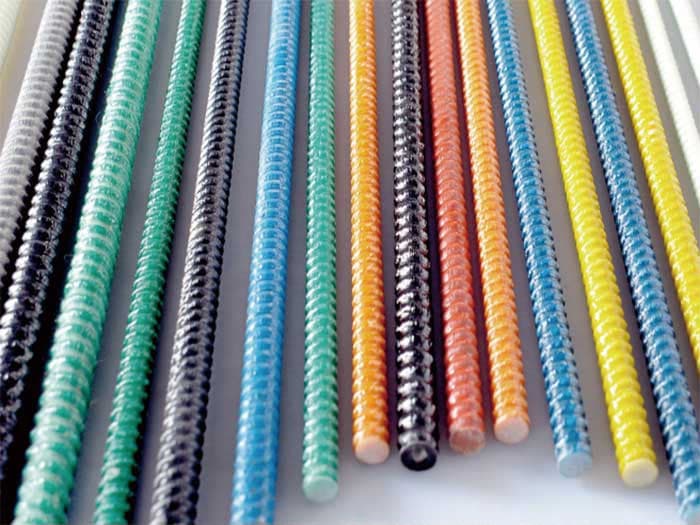
Product Overview
Lightweight. Corrosion Resistant. High Performance.
Our manufacturing process combines continuous glass-fiber reinforcement with a controlled polymer matrix to produce lightweight composite reinforcement bars designed for demanding concrete applications.
It is designed for concrete reinforcement applications where corrosion resistance, reduced weight, non-metallic properties and long-term durability are important.
Manufactured in Karachi, Pakistan, PGFRB GFRP Rebar is being developed for projects across Pakistan and international markets, including the GCC, Africa and worldwide markets.
At a glance
- Product
- GFRP reinforcing bars
- Composition
- Continuous glass-fiber rovings in an epoxy resin matrix
- Diameter range
- DN6–DN35 (6 mm to 35 mm)
- Lengths
- Multiple lengths according to production capability
- Manufactured in
- Karachi, Pakistan
- Markets
- Pakistan, GCC, Africa and worldwide
Why PGFRB GFRP Rebar
Key Advantages
- Corrosion resistant
- Lightweight
- High strength-to-weight ratio
- Non-metallic
- Non-magnetic
- Electrically non-conductive
- Easy to transport and handle
- Suitable for demanding environmental conditions
- Available in multiple diameters
- Manufactured in Pakistan
Our Current Product Range
GFRP Rebar Sizes: DN6–DN35
PGFRB currently has production configurations for GFRP reinforcement bars ranging from 6 mm to 35 mm diameter.
- Standard diameters
- 11
- Diameter range
- 6–35 mm
| Product | Diameter | Nominal weight* |
|---|---|---|
| DN6 | 6 mm | 0.055 kg/m |
| DN7 | 7 mm | 0.075 kg/m |
| DN8 | 8 mm | 0.097 kg/m |
| DN10 | 10 mm | 0.150 kg/m |
| DN12 | 12 mm | 0.220 kg/m |
| DN16 | 16 mm | 0.390 kg/m |
| DN18 | 18 mm | 0.500 kg/m |
| DN20 | 20 mm | 0.610 kg/m |
| DN25 | 25 mm | 0.960 kg/m |
| DN30 | 30 mm | 1.380 kg/m |
| DN35 | 35 mm | 1.880 kg/m |
*Nominal weight per meter values are production-configuration values, to be verified against finished-bar measurements during quality control. Custom cut lengths are subject to production capability.
Technical Information
GFRP Rebar Technical Information
GFRP reinforcement behaves differently from conventional steel reinforcement. For this reason, engineering design should consider the specific mechanical and durability characteristics of GFRP.
Key properties to be specified
- Bar diameter
- Nominal cross-sectional area
- Tensile strength
- Tensile modulus
- Ultimate strain
- Glass fiber content
- Resin system
- Bond characteristics
- Surface profile
- Density
- Thermal properties
- Durability performance
- Environmental exposure
GFRP is anisotropic. Its design properties, stiffness, development length, bend behavior and environmental reduction factors must be considered using the applicable engineering provisions — it should be specified as a composite reinforcement material, not a direct replacement for steel.
Technical performance — testing in progress
PGFRB is currently undertaking laboratory testing of its finished GFRP rebar. Verified values will be published once test reports are issued and approved.
- Tensile strengthTesting in progress
- Tensile modulusTesting in progress
- Ultimate tensile strainTesting in progress
- Glass-fiber contentTesting in progress
- DensityTesting in progress
- Bar diameter toleranceQC verification
- Bond / shear performanceTesting in progress
- Water absorption / moisture performanceTesting in progress
- Alkaline / durability performanceTesting in progress
- Thermal / Tg propertiesTesting in progress
Technical Documentation
PGFRB is developing a complete technical documentation package covering product specifications, testing and application guidance.
Site Guidance
Handling, Storage & Installation
GFRP bars should be handled in a manner that prevents damage to the bar surface and profile. Bars should be supported during storage, protected from unnecessary impact and kept in accordance with the manufacturer’s handling instructions.
Recommended practice
- Store bars on suitable supports to prevent excessive bending or sagging.
- Protect the bar surface from sharp impact, abrasion and uncontrolled cutting.
- Use appropriate lifting and handling methods for bundled bars.
- Keep products identified by diameter, batch and production information.
- Cut bars using suitable tools and procedures specified by the manufacturer.
Avoid
- Do not weld GFRP bars.
- Do not field-bend bars unless the product and design documentation specifically permits the method.
Final installation instructions should be based on verified PGFRB product data and the applicable design standard.
Request a Quote
Tell us about your project and reinforcement requirements.